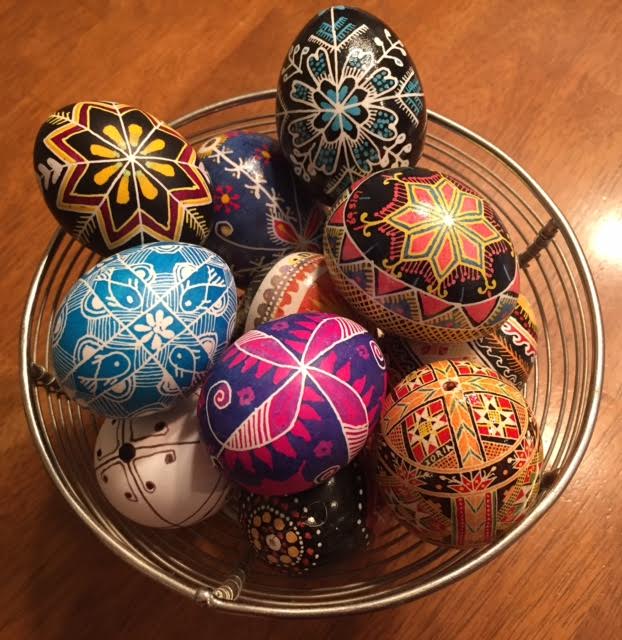
Pysanky is a very cherished art to me. The method of egg decorating known as pysanky comes from the Ukrainian verb pysaty which means “to write.” You’ll notice I switch between pysanky and pysanka. Let me just explain to avoid confusion; pysanka is the singular (one egg) while pysanky is the plural form (many eggs or the process in general). In the Ukrainian culture, this art is held in high esteem and in the olden days carried a dominant role in their spring rites. Today the meaning has changed and receiving a pysanka egg is a gesture of peace and goodwill. Each egg is tailored to represent specific needs of the receiver, perhaps a need for a good harvest, or a desire for fertility and whatever else one stands in need of.
To understand this beautiful art, one must learn about the meaning behind the colours, and motifs/designs. White represents purity, black suggests the darkest period before dawn, yellow symbolizes both wisdom and a plentiful harvest. Green carries with it a sense of rebirth and its many different associations – freshness, innocence, and youth. Orange is a very important colour, as it is a combination of red and yellow. Viewed as yellow of wisdom and red of passion, it also is the colour of the sun with its attributes of warmth, endurance, and power. Brown, as one might think, represents the earth and our connection with it; while purple is associated with royalty, representing faith and trust in the power of pysanky. An egg with black and white combinations summons protection from harm and honours the dead as well. Just as all of the colours have meaning, so do the motifs and designs. To mention all would take me numerous pages, so I will mention only a few. The most powerful one is the circle, as it is viewed as a symbol of protection and one that evil cannot penetrate. An endless wavy line illustrates eternity. Triangles represent trios like mother, father and child, or fire, wind and water, or the Holy Trinity in the Orthodox faith. Various animal symbols denote the fulfillment of wishes. For example, if your friend was childless, you would put a rooster into the design on the egg you were creating for her, for increased fertility. As well, you would include floral in your design as it embodies love and charity.
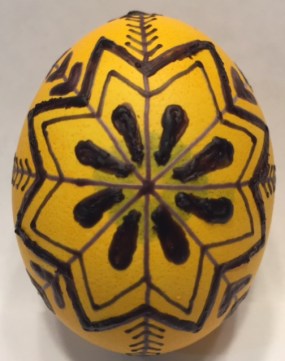
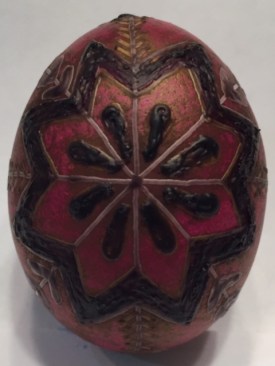
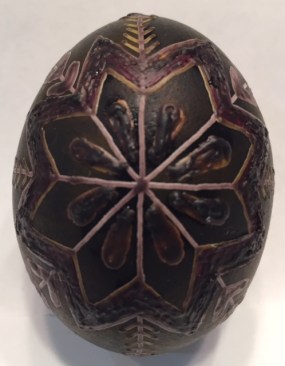
Now that you have a small understanding of pysanky, let me tell you how you create this lovely art. First thing is to hollow out your eggs. You do this by poking a needle into the top and bottom of the egg, making a slightly larger hole on the bottom. Then you blow into the top hole until you get all the egg guts out. Be sure to poke the yolk to break it though, or you might blow your own guts out. I also tend to rinse them with water a bit once all the egg is out, just to make sure I got it all. After your egg is empty and dry, it is ready for the first step of the pysanky process. This is done using a kistka tool with various sizes of tips that you load pressed beeswax into, then heat and draw on your egg with the wax, creating the egg using a batik method. You must layer your colours on from light to dark, keeping in mind the colour wheel as previous colours on your egg will have an effect on the next colour you dip it in. Your first colour is white (the egg shell itself), and then yellow and so forth. When you are finished with the background colour, you will have a dark egg. That is when my favourite part comes in. You hold your hollowed-out egg that is fully designed with colours hidden by the wax at an angle over the flame of a candle. Slowly, the wax melts and your colours are revealed. You must be very careful not to destroy its beauty by holding the egg too close to the candle and making a carbon burn as you remove the wax from your egg.
One of the blessings of this art is how I feel a connection to my dear Aunt Dorothy, who taught me this as a child. Aunt Dorothy was a kind, patient soul who warmed my heart and I was eager to be her pupil. I have taught my family and hope they carry this tradition on. I have also taught it to many friends as well. Another blessing is the lessons l learn as I spend contemplative hours with this art. Those hours bring me peace and joy. It has taken me many years to learn all I presently know, and I am still learning new techniques and designs that keep me interested. On many occasions, friends will come join me for a night of pysanky and time flies! I still giggle when I reflect back to a night where a friend and I were so immersed in conversation and pysanky that we didn’t notice the time until her husband called. It was only 3 AM, we told him, but it was a school night and we both had young children that would be up in a few hours! Neither of us regretted that evening and we still remark fondly that we need a repeat of it, as it was so satisfying and memorable.
Some pysanka will require a few hours to finish and others I have done took me twenty to thirty hours to create. (Sadly, I didn’t take pictures of those masterpieces.) The whole purpose behind this art is that the pysanka is to be given away, not kept. I have spent many hours in my life over the span of 40+ years, learning, practicing and teaching this work of art. It has been my pleasure to present pysanky as a gift to my friends and seeing their delight leaves me feeling an even closer bond of friendship. I am grateful that my children have also chosen to learn and embrace it so that they might pass it on to their children one day.
Looking back as a young teenager, I can recall another experience that still stands out in my mind. We had an honoured guest, Charles Didier, who came to our home for supper. My mom had seated us in the dining room and Charles had commented on the beautiful eggs he had viewed in her china cabinet. Immediately, without hesitation, my sweet Ukrainian mother did as her heritage taught her, and offered him any egg he admired as a gift. I had just finished an egg that I considered my best and wouldn’t you know it, he chose it. I wasn’t happy at that moment since I had just spent days creating my masterpiece and it left my home hours after being finished. However, as I have gotten older and wiser, and understood the culture better, I realize that was, in fact, my first step in experiencing true sacrifice. Now, I am grateful I didn’t act like a child and refuse my mother’s invitation to Charles Didier.
I have grown to love the Ukrainian culture and this beautiful art of pysanky as I have progressed and worked at it for many years. I feel rewarded as I ponder upon all the cherished memories of family and friends gathering to create pysanky. For me, the wondrous eggs are a reflection of the beautiful loving culture of Ukrainians!
Pysanka process of an egg, minus the white (eggshell) step I forgot to photograph



 LoLo's Sunshine